
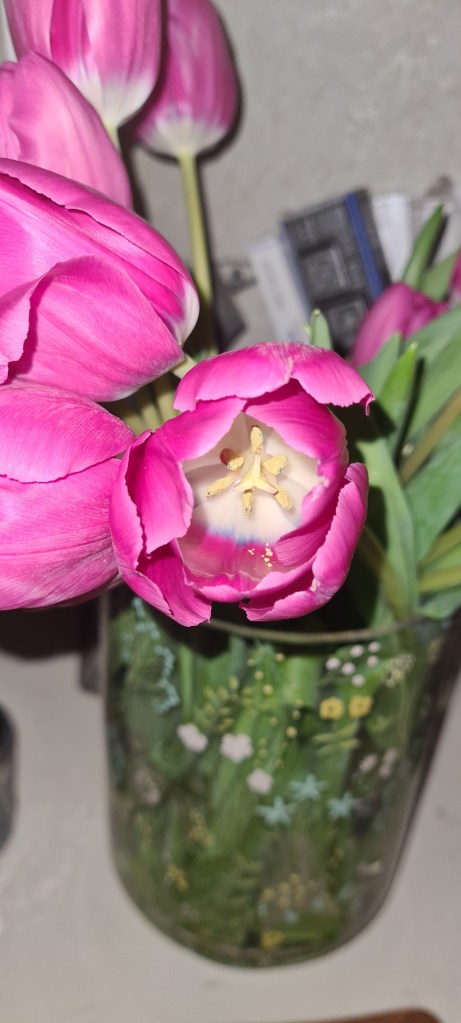
I went to the supermarket this evening to pick up a few bits and bobs and they had these beautiful tulips on sale for 10p! I thought I could give them a good home and they can be used for my Ostara Altar display too.

Tulips usually flower in April and May, but high demand for them for Mother’s Day in mid-March has them forced grown in the Netherlands, in huge fields as far as the eye can see.

Due to the wide variety of colors and shapes, tulips are thought to be one of the first flowers cultivated solely for their beauty.
Many people think tulips originated in The Netherlands, but in actual fact, tulips were first discovered in Turkey around a thousand years ago. There is little history of the tulip in Europe until the early 1500’s, when the Turkish introduced them to European traders and explorers. From then on, tulips spread across Europe, particularly in Holland, where they were prized and later became the National symbol, were associated with good luck and fortune, as well as love, and often cost more than gems and gold.
As far back as 2200 to 1600 B.C. tulip designs can be seen on pottery and have also been found on fabric from the Byzantine century.
Tulips are most commonly referred to as the symbol of perfect love and the Turkish people used them in love potions, or placed them on altars during love spells. They can also be used to increase desire and build relationships, both new and old.
Furthermore, tulips are also used in colour or flower language. Red is a declaration of love, yellow hopeless love, and black meant a heart burning with love.
Apart from their association with love, tulips also project other positive energies such as prosperity and protection.
They were often worn to safeguard against poverty and bad luck and are also sometimes associated with dream work, fame and protection. They can also be used in magick regarding gratitude, simplicity, happiness, beauty, and prosperity.
There are very little medicinal uses for tulips, likely due to their cost throughout much of history. However, a poultice made of tulip flowers can treat and soothe rashes, stings, scratches and minor burns. Tulip oil can also be used as a house freshener or added to baths and massage oils to uplift vibrations.
TULIP POULTICE
• To create a poultice of tulip flowers, you’ll need to warm 2-4 flowers in hot water.
• Place a towel into hot water and put the petals inside the towel.
• Lightly crush the petals and apply them to the affected area.
• Hold in place for 10 minutes using the warm towel.
Petals can also be combined with castor oil, especially for treating burns and insect bites.
 Melusina The Green Witch